Reframing the Sustainability Argument
 Continuing with thoughts regarding sustainable design as a key goal for those looking to build “Green”, you’ll find an essay re-posted from Robert Husted’s most relevant and interesting blog site.
I found Robert to be a very insightful and interesting person. Although we have never met, he graciously shared with me that, originally from upstate New York, he lived in India for a year after high school. His time there made a life-long impression. Later, he lived in Mainland China for a year and has spent a great deal of time in Mexico and Asia. In Robert’s words, “I feel like my posts have outlined my vision of how to achieve sustainability and eliminate poverty within 25 years. My next post deals with how to start implementing the plan.” I look forward to reading it.
The next few posts on my site will continue to share elements for sustainable design. Designing for sustainability is about conserving resources; natural as well as financial. By nature, if done creatively, sustainable design, true “Green” should not take more “green” to construct. For those of us who wish to truly be good stewards of our planet, minimizing the amount of materials needed to build our homes is as important as the kinds of materials we use, where they come from and what kind of resources it will take to power them up, heat and cool them.
Lifestyle adjustments will be made, but as a society, we have been making many of those adjustments already. Some changes, like reusable grocery bags, we’ve made out of a sense of social responsibility. Some changes we’ve made, like driving smaller and more fuel-efficient cars, stem from economic need as well as social responsibility. We’re buying more organic and locally grown food than ever before for many reasons.
In the next several posts, I’ll attempt to show many features you can design into your home construction project that will add immediate as well as long-term value, and at the same time, lower costs. And we won’t need a label to prove it! I will show that smart design does not mean living in a “tiny house” using a SSS bathroom. RV dwellers, you know what I mean! 
Reposted from The Sustainability Puzzle February 23, 2012
Reframing the Sustainability Argument: It’s about How We Organize Ourselves
Like a doctor treating a medical problem, without accurate and good information, the doctor can’t diagnose the problem correctly. And, without an accurate diagnosis, he or she can’t develop a proper treatment. Our society works in much the same way. If the general population is not given accurate information about our sustainability problem, how can we expect them to realize that the treatment and its urgency are appropriate for the scale of the problem?
From our past experience, we’ve learned that the solution to our economic problems is through creating more jobs, more manufacturing and more consumption of goods. The problem is that this solution clashes with our environmental reality—the way we live consumes too many resources and it is only going to become worse because of our population growth. However, if we are content with a permanent economic underclass, then it may be possible to continue the current paradigm in one form or another.
The CBC documentary Surviving the Future echoes what is the common perception about how we will reach a sustainable future – through better technology. I clearly reject this notion because the key to sustainability is in how we organize ourselves. Solutions based on this assessment can be achieved with our current state of technology. Time is more important than technology in determining our success because the longer we wait, the more complex and larger the problems become.
Our growing population is having a devastating impact on our environment and can’t continue. Imminent ecological system collapses include fish depletion, water table depletion and the influence of fossil fuel, not only on the environment, but on our society. It has distorted who we are as humans and our basic moral code of treating others as we would like to be treated is being compromised.
The good news is that, strictly speaking, we have enough resources and adequate technology to allow everyone a dignified life. However, our current systems require a great deal of waste in order to work. It is how we live that is creating these devastating consumption patterns that jeopardize our future. At some point, someone needs to be the adult in the room, stand up and make everyone face the facts. How do we do this in our world with 7 billion voices?
At times I feel like I am alone in this argument for urgent action, but I know there are others such as David Suzuki that have a much larger sphere of influence and still there is not even a murmur of concern in capitals around the world. Yes, there are documentaries such as Surviving the Future and online groups such as the Future We Want.
Our failure to address what is probably the largest issue that humanity will face is a combination of a lack of leadership, the distraction that occurs with too many voices and the faith we place in the current economic paradigm.
The scope and scale of the problem requires a global response because it is both an issue of population and resources. We can no longer afford to cling to quaint notions of a world with limitless resources. A few generations ago when the world was less populated global coordination was not necessary, but today’s growth rate makes it imperative.
As always, your comments are greatly appreciated.
Share this:

Greenwashing or The Real Deal?
 What is “green” How do we know what a green label means except $green$? Are there standards?
All good questions and impossible to answer in 700 (or maybe 900)words or less.
The word Green has been bandied about for several years. Products are constantly emerging on the market for home improvement that profess to be “green” so that when we buy them, we feel that we have done something good for our environment. Some products are much better than others. Some are only in part. Some aren’t at all. How do we know? Currently, there are no universal standards required for calling a product green. It’s not at all like an “U.S. Certified Organic” label on food. Various trade organizations have created their own certification programs. As of yet, there are no National standards.
The National Home Builders created the Certified Green Professional Program For between $420-$630 a contractor with 2 years experience can take two courses, fill out a graduation application (with another $145-$218), and voila! Green Certified! There is a Green Seal Certification, a Simply Green Certification, LEED Certification and dozens more.
Consumer Reports offers a source for checking “green” labels. The site provides a search by label that I found less than helpful. I wasn’t able to enter any information unless I knew what claim the label is making i.e. biodegradable, environmental persistence, sustainable fishing, etc. Entering the National Home Builders turned up zero results as did the three other certifications above.
Examples:
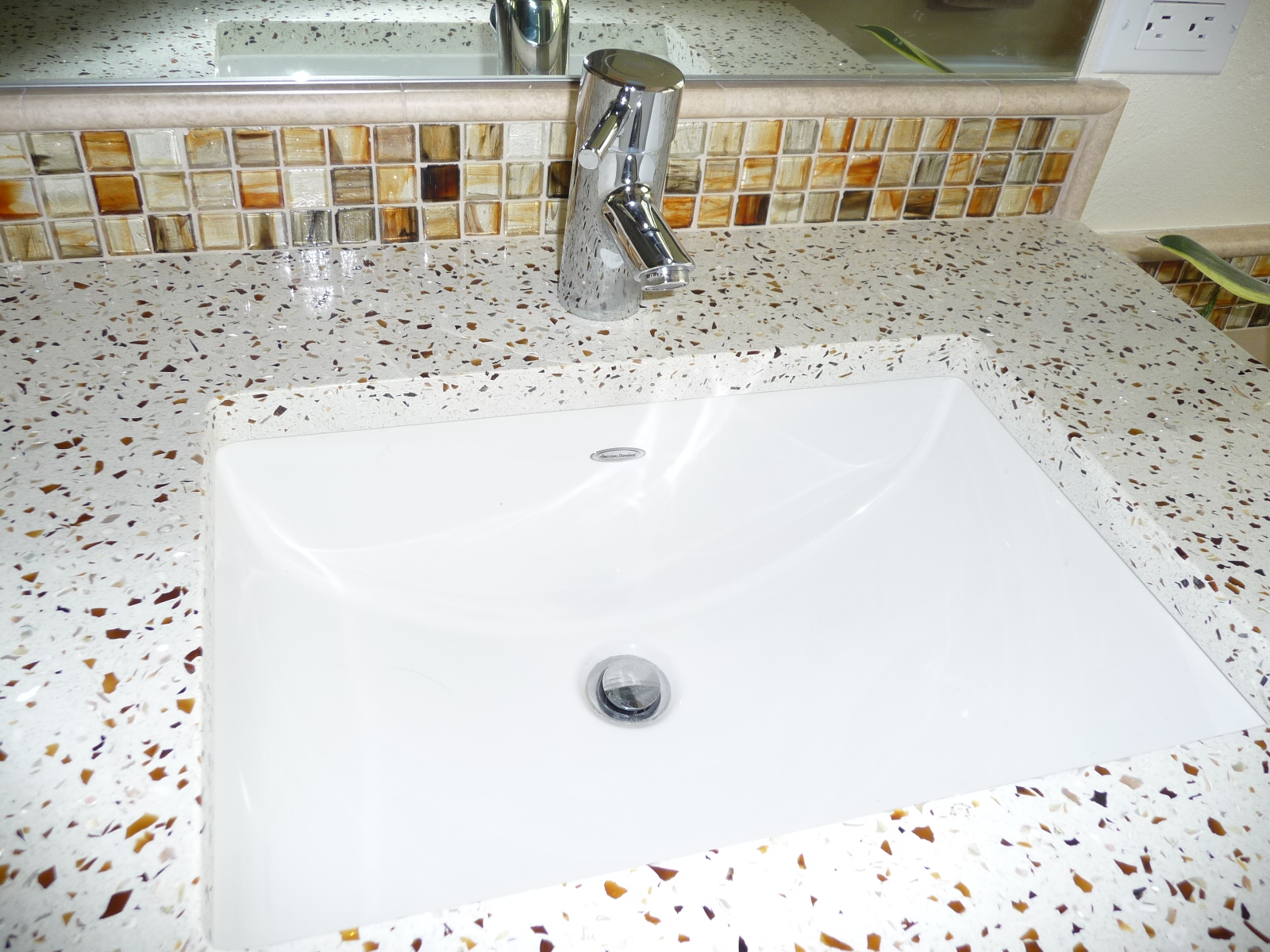
Vertrazzo Counter Top
One interesting product I have tried to research is Vertrazzo; an 85% (so they say) recycled glass counter top brought to market in 2006. Touting greener than granite due to the amount of carbon needed to bring Granite from other parts of the world and their own report (no source quoted) of unfair labor practices used to quarry the material, the product became a big seller in the higher end home construction and remodel market. The story was inspiring. Counters made of waste, “including 125 tons of waste glass not recyclable”, and manufactured in a, “state-of-the-art manufacturing facility in a remodeled Ford auto plant”. The workers had a dream work environment and full benefits.
Where is Vetrazo today? They been purchased by Polycore, Inc. This company quarries and finishes marble advertised as quarried in America. But what are the working conditions in their plant? All I could get from their website is that they recycle because, some workers were already collecting cans and “Though our efforts might not scream “green”, we think starting small is better than not starting at all.”
I have never been able to find out what the 15% non-glass materials used to make the slabs consists of. If anyone out there knows, please tell me. I’ve found this product to be less than stellar in my own Sustainability rating. It chips easily and needs repair.
The price for Vetrazzo? Approximately 3 times the amount per square foot as granite. Environmentally responsible consumers are paying it, but are they getting their money’s worth? All that aside, it looks fabulous in the proper context!
Another example I can share is Sherwin Williams No-VOCpaint. Low emitting paints get 4.2 LEED Certification credits, but what does that mean? We know that VOC’s are not good for our environment or our lungs, but what about this particular paint. Spring 2011, a physician client of mine broke out in an ugly and possibly life threatening allergic reaction after we painted their 3 bedrooms with it. The painter had another client who had the same reaction the previous week. When our local Sherwin Williams dealer was confronted, they admitted it was a problem but confided that it’s supposed to be good for us and what are they, the local store, supposed to do about it?
January 2011, the Better Business Bureau put out an article condemning Sherwin Williams for misleading it’s customers, in some cases, about the VOCcontent. It didn’t mention the allergic reaction experienced by some consumers. The product never left the shelves. The painters I’ve spoken with are using a lot of No VOC paints because consumers are demanding it. They are finding it harder to work with and it covers very poorly, more coats are needed. More product produces more environmental waste and consumer cost. Do consumers understand the trade-offs before deciding that they want to use these products.?
While editing this post this morning, a tweet popped up from Jetson Green (@Jetsongreen) sharing the announcement that Home Depot is now offering their LEED Certified Line. My excitement was palpable, as I’m sure you can imagine! I invite you to look at the products being offered as “Green” with the LEED points proudly displayed and ask yourself, REALLY? Delta Faucets are “Green” because they are water saving? Really? What are they made of and how are they made? What Green standards are in place at their factory?
So what does this mean for the average consumer of home construction materials? Can you say , “Greenwashed”? The link is to a blog that is a bit old, but the 7 Deadly Sins of Greenwashing are still relevant today. I wanted to share. All that’s labeled Green, is not automatically worth 25%+ more cost and unfortunately, you can’t know that you are doing the most responsible thing for our mother earth either. Instead of Green, I much prefer to think Sustainable. If we all take a little time in our day to be environmentally cognizant by recycling, picking up trash that we step over, turn out lights, use less paper products, unplug unnecessary inverter boxes, use the stairs, drive a little less………you get the idea. We can do a lot more for our environment than the impact we have when purchasing building materials with a label. Buying from companies that work to be more holistically sustainable will be better for our global environment. We have to read labels and do our homework in the same way we read labels on the food we buy.
When designing your home construction project, try to think sustainably, more than Green. Design using natural solar power, use mass and proper solar orientation. Design with minimal home foot print to maximize energy conservation. Design using renewable materials, from sustainable companies. If you’re interested, I’ll be revisiting this subject with more details as I blog along.
If anyone has any experiences to share about Green Labeling, or products you have been happy or unhappy with, please share.
Share this:

Putting Your Material Design Together
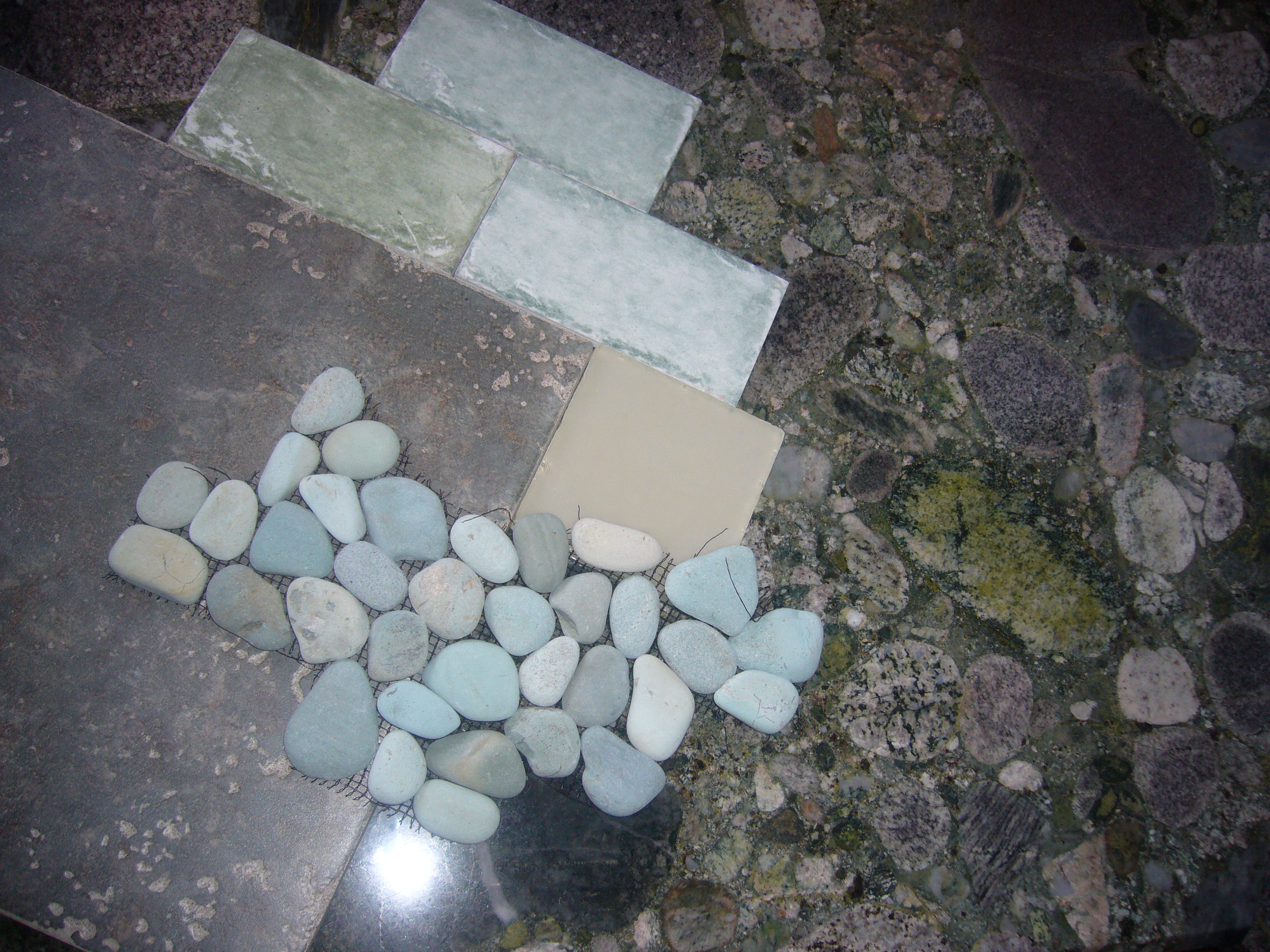 Now that you’ve gotten organized and educated, you can start sorting through your ideas for putting your design together. Start sifting through all of your photos and samples you’ve gathered and see if you find a pattern. Are most of the photos of kitchens one style or color of wood? Do most of the bathrooms show a more linear design, square tub or sinks, or do you see rounder shapes? Does one color scheme stand out more than others? These are all clues about the style that you are really attracted to. You might like a particular style in a magazine when you see it and have some photos in that style, but in my experience, majority rules here. Your collection of photos speaks to your comfort zone. However; don’t lose sight of your furniture style and the style of your home’s exterior or interior architecture.
If you’ve gotten this self-help homework done, you’re ready to go to work, building the design. Using a Design-Build General Contractor, the design service should be part of your contract.
Design-Build Contractor:
The Design-Build Contractor receives discounts from material suppliers in your area. With a Cost-Plus contract, you should be receiving contractor’s cost on all of your materials, or understand clearly why not. Those discounts make buying from local suppliers a cost effective smart idea. Your local vendors will assist with any issues that develop with their product. Many will even work with customers that are introduced through contractors when they are unhappy with a product. The material supplier and the contractor have a relationship that is valuable to the store and worth of customer service time to preserve. If a problem develops with a plumbing or electrical fixture that was purchased locally, the supplier will most often order a new product from the manufacturer without needing to return the defective one first. That can mean not having to do without until the new product arrives. It can mean limiting your plumbing or electrical contractor to one trip; take out and put in. In some cases, a trip charge that can cost more than the defective part! Can you see now why those deals on the internet might look less and less attractive to you?
Design Only Professional:
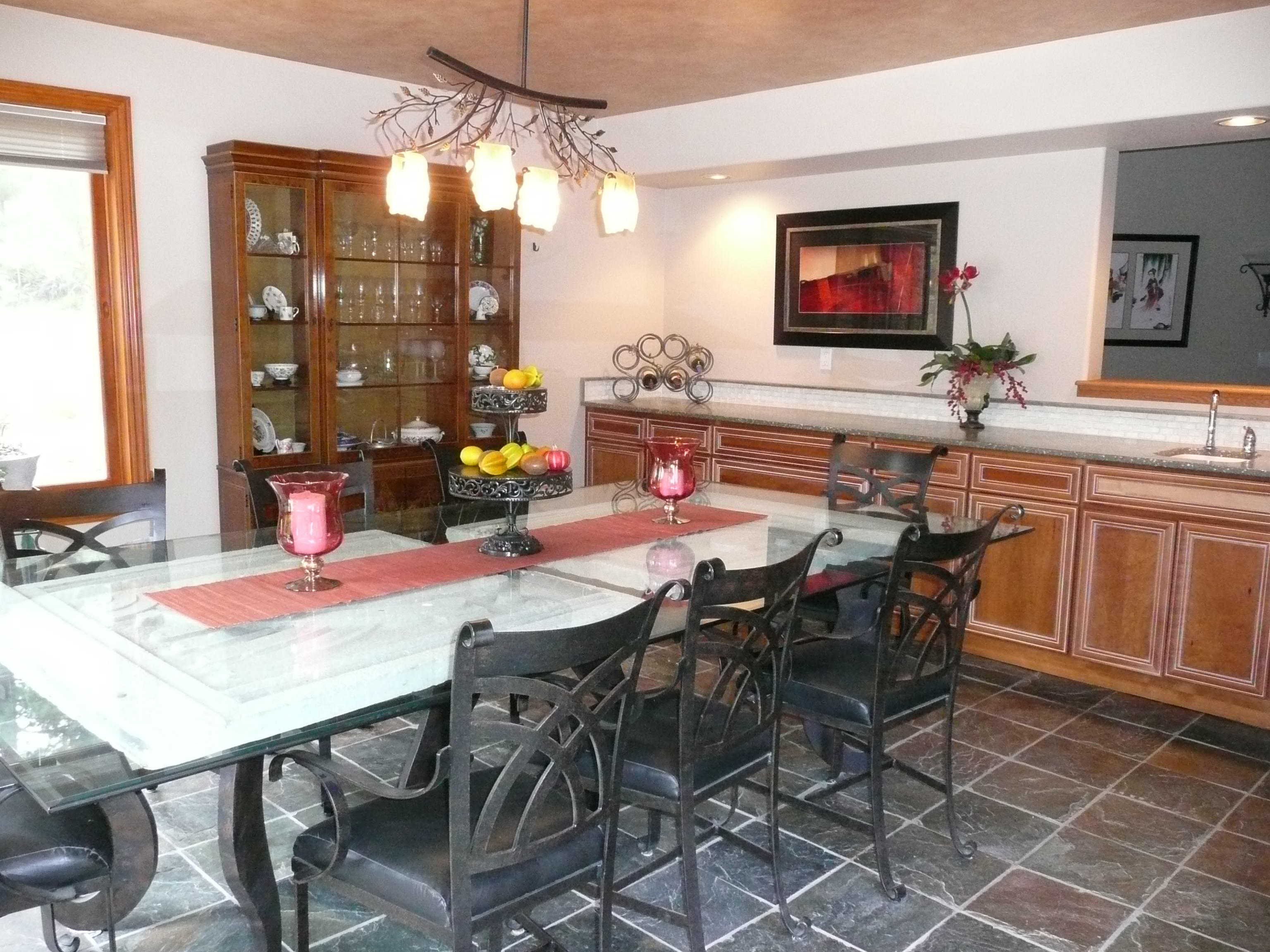
Suncrest Builders, Inc.
Without a Design-Build Contractor, you might be considering a licensed Design Professional. It’s a difficult decision. A lot of money will be invested into your project materials. It doesn’t take more than a couple of mistakes before the Design Professional isn’t looking that expensive. On the other hand, we all have friends who have done a beautiful job with their finished design without paying for assistance. Designers, like Contractors, receive discounts from their material suppliers. In the case of finish construction design materials, I receive up to 35% on some materials. By passing on that discount to their customers, the fees become much more cost-effective. If a Designer isn’t offering their discounts, consider asking when discussing their fee. If their fee is substantial AND they are receiving the discounts; that’s double dipping!
When to bring your Design Professional in to help?
Day 1 is the short answer. If you’re really going to get your money’s worth, you’ll want to consider window coverings and furniture placement before finalizing the design to ensure you have the proper space. This won’t require a lot of hours, but will save money and aggravation down the road. A good Design Professional will work with you as an adviser to introduce you to their library of experience and education. They will help you through the dozens of decisions; from drywall texture and woodwork or trim, as well as finished fabrics, etc, if you desire that help as well.
Going it alone:
If you are unable to use a design professional due to budget constraints or determination to learn about construction and interior design, but have never done anything quite like this before, there are as many How-To design blogs for design as there are for laying tile, or painting, or other skills developed by craftsmen. However; I do have some advice for you.
Don’t pick anything until you have decided on everything!
If you’ve been following my posts, you’ve seen this before, but I can’t say it enough. Gather up decently large samples for your box. Order and pay for bigger samples, if need be. Colors change as they get larger. Color changes with a change in texture. Color changes when reflecting off of other colors in the room. NEVER select a color from a magazine without ordering a sample and putting it in your mix. NEVER select paint from the little squares. Buy quarts and brush them on a poster board size sheet that you can move to your samples or against cabinets. NEVER paint paint on a wall next to other colors. It changes with the reflected colors. And again, start thinking about all your materials as one big outfit. You’ll want to gather all of your tile, flooring, wood samples from cabinets, lighting metals (if available), paint, and look at them all together.
If you’ve been following me, feel free to let me know what topics you want to know more about. As always, I am happy to hear your comments or questions.
Share this:

Becoming An Educated Shopper
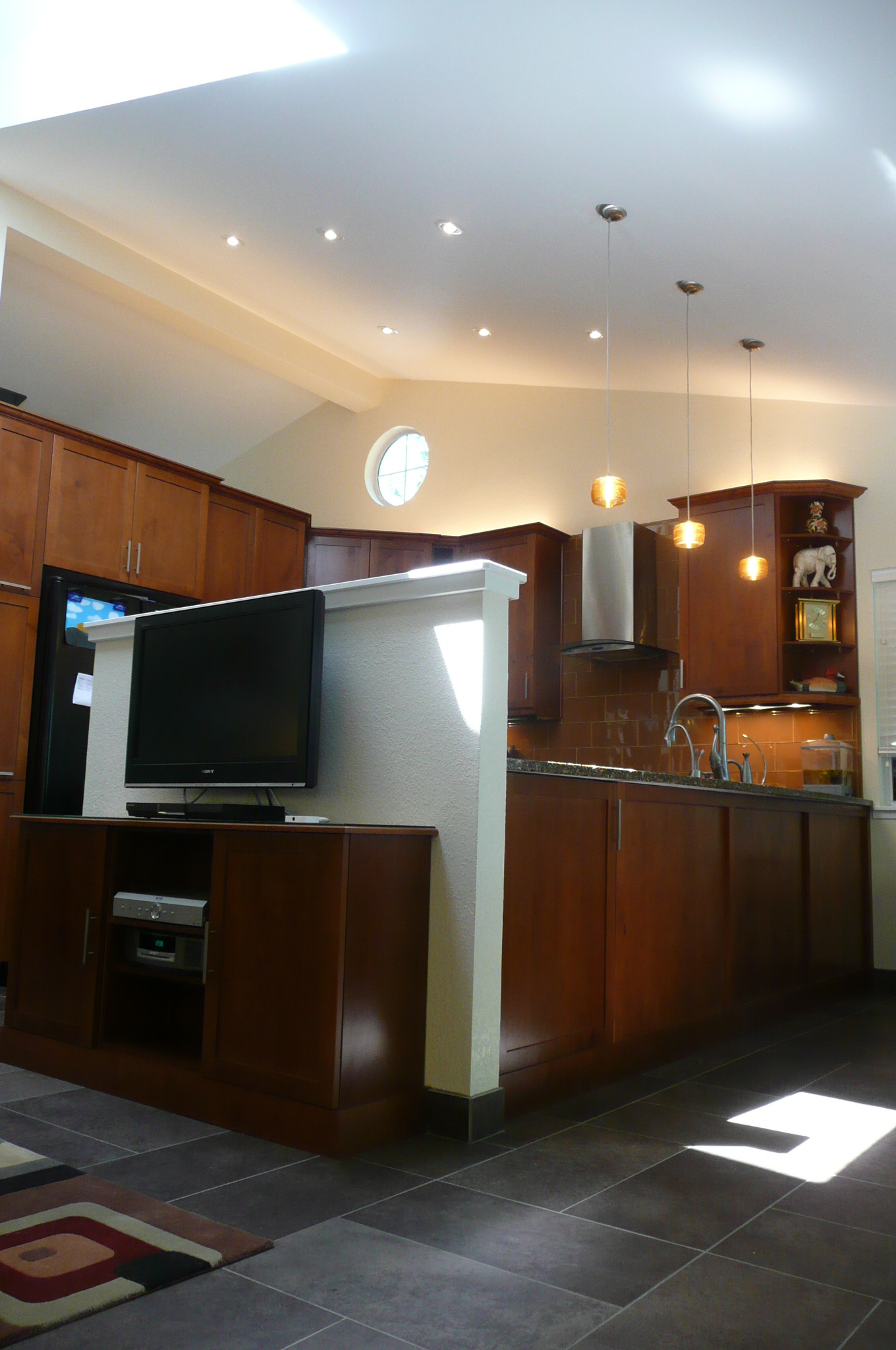
Suncrest Builders, Inc.
Becoming an educated consumer of home improvement and construction products is time consuming and not nearly as fun as picking out colorful fun materials, unless you’re a techno-nerd. If you are, you’re one of the special people, we all know it. Please don’t gloat. For the rest of us who don’t find reading spec sheets our idea of a fun filled evening, I have some advice.
There are three main ways to shop for products and materials once you’ve gotten your idea binder started.
1. The Internet- Of Course
The internet has a lot of information regarding product specifications and makes the preliminary hunt much more efficient.
For plumbing parts and appliances, I recommend going directly to the manufacturers websites. For many products (appliances, plumbing, lighting), you’ll find a tab titled “spec sheet” or some similar PDF file. When you find products you like, print out photos, spec sheets, and any other information you can find. Put it in your project notebook.
The manufacturer’s sites show their products that are still available. You’ll be able to find the latest and greatest functions for appliances and plumbing materials. The manufactures sites will give you a better idea of style trends for all products. If you are looking to get the best value for your investment, you’ll want to start in the future. Similar to buying a car, last year’s model will save you a bit in the front end, but you’ll lose the savings when you sell it. The exception to this is if you are going to run this car into the ground. In that case, last year’s models that are new in the box can be a very good value, but you should still be aware of what is coming down the line. More often than you think, pricing decreases or additional features for no additional costs, make the close outs less attractive.
Make notes regarding your preference for style, colors and material. Technology changes and manufacturers of home products are constantly changing their product lines. No one is expecting you to become an expert from reading some websites and I hate to break it to you, but you will not become an expert from watching HGTV either. If you do your homework before selecting your construction team leader, you will have chosen a team leader and expert who will be there to consult with you.
That said, finding out about product availablity and an idea of what things are going for in the market place can help you arrange your priorities.
Look, take notes, but don’t buy no matter how good the ” deal” seems to be. There will be other sales.
2. Local Show Rooms
I’m a huge fan of supporting local business’s for a variety of reasons that will be a future post. For now, suffice it to say that when you find reputable, dependable, service orientated local vendors, you want them to stay in business.
Doing your homework so that you know where your interests lie, will save you a lot and gas. You’ll be able to find the local store that has the product lines you are after. Go to the show room and ask for an experienced and knowledgeable person who can share their expertise with you on the products you’re considering. The vendors will tell you if particular models have been untrustworthy. If there have been problems, they wind up having to take it back from you, jeopardize their relationship with you, and then ship it back. Sometimes their customer service efforts cost them more money than their mark-up for the item. Vendors, in general, do not want to lose living breathing customers over bad products.
But at this stage, again… look, take notes, but don’t buy no matter how good the ” deal” seems to be. There will be other sales. Trust me.
3. Your Contractor
Suncrest Builders, Inc.
Your contractor can be a very good source of information. She won’t have had experience with all of the models of products out there, but she can find out what is being said behind the scenes. Her vendor will tell her what products give the best performance for the price tag.
A word of caution about website prices, show room sales, Craig’s list deals, etc.; don’t by any “great deals” anywhere, before giving your contractor a chance to look it over with you. I’ve had some very disappointed clients who’ve scooped up a prize, only to find out that it isn’t going to work in their project for a variety of reasons. Some manufacturers make an inferior product to sell to the big box stores. It looks the same, is named the same, but it isn’t the same. Plumbing products are very commonly found to be this way. Clue: The same faucet at a box store can weigh noticeably less due to plastic guts instead of brass.
One client of ours purchased a whirlpool tub on the internet only to find that the motor placement had been a special order and didn’t match the specifications for that product found on line. When it was time to install it, the $500 he saved cost him all of that and then some because of the expense needed to move the access and plumbing supply lines.
Always use your Contractor as a resource before making your final purchase. If your contractor reads the spec sheet and decides that the product is going to work for your project, the ultimate responsibility for the decision rests with him. That’s better than resting with you, the owner, no matter how educated you believe you have become.
And one more little piece of advice that has become a mantra of mine:
Don’t buy anything until you have selected everything.
I’ll explain more on this in another post.
Do you have any information to add to what I’ve written that can help others when shopping? Please share your valuable experience.
Share this:

Let’s Get Organized- One Step At A Time
Suncrest Builders, Inc
After delineating your “Scope of Work”, or your “Wish List”, it’s time to create a system that will keep you organized as you begin to educate yourself about all of the different products available on the market that relate to your project needs. Establishing your system to organize your research is a crucial component for a successful home construction project.
I highly recommend: The three ring binder with dividers, pockets, and page sleeves.
You will want three binders.
You’re going to be organized, even if it goes against your core values, lifestyle choices or DNA. Everyone is going to go it their own way, of course, but if you can take my word for this, I expect that you’ll write me later to thank me. (Just put your thank you note in the comments box below!)
When I first started out, I had everything in file folders, as do many of my clients.
The problem with that system is that it’s hard to carry around all of the folders with you. Papers seem to get lost as you shuffle around looking for that photo you want. However; dropping those file folders on a show room floor or parking lot can be a real attention grabber, if you’re looking for that.
A client and now friend, Diana, shared this system with me many years ago. When at her home construction site talking about the issues we had planned on, I always had my big fat file folders with me at the ready for the areas we had planned on reviewing. Invariably, we would need information from previous decisions. I didn’t have those folders. Diana ALWAYS had that information in her three ring binder. Embarrassing for me! That was the last project that I used the folders on.
So find a fun binder that you can grow into and create tabs on the dividers for each major project category. For example: plumbing, electrical, appliances, cabinets, drywall and paint, roof, windows and doors, finished trim, tile and stone, flooring, glass and shower enclosures……depending on the scope of work that you have developed.
Binder number 2 is for information you collect on the professionals you will contact and interview. If you are interviewing several contractors, you will probably want to create a tab for each. You can keep the information they give you there. You’ll keep your notes on the calls you make when checking their references. If you are pursuing a loan, make tabs for your bankers. You might need a tab for your insurance adjuster, when you are rebuilding from loss. After starting your project, the professionals that you will be working with will go into the project notebook. But in the beginning, keeping them separate will minimize the load you’ll have to carry with you.
When meeting with any members of your professional team, bring your binder, and write notes about your conversation in their section. Much confusion, for you and your professional team member can be avoided if you keep notes. If promises or changes have been made, I recommend sending an email after the meeting reiterating your notes to ensure that all parties are on the same page. A copy of that email can replace the note page in your binder.
The third binder will be for your financial records. We’ll cover that in another post.
One last thing: Get a box for the real life samples that you’re going to collect. Plastic storage boxes that slip under a bed work well and so do big baskets. Anything that works for you.
You’re now ready to start your research project.
Do you have additional organizational tips that you can share? I love getting new ideas and always appreciate the comment.
Share this:

How To Get Started On Your Design
“Where to start ?” is a question I get asked by family and friends as well as clients, all the time. Before finding a professional to work with, I highly suggest that you start getting your ideas in order. The type of project that you decide on may determine which type of professional you will ultimately hire. For example, if your project is going to involve a number of high tech products, energy upgrades, or a net-zero home, the contractor you choose might be different than one you would select to remodel your guest bathroom. That example is obvious, I know, but you get the idea.
Design by Suncrest Builders, Inc.
It may be your wish list until you get pricing, but outlining your “Scope of Work” will help to ensure that the design professional you’re working with has everything included from the beginning. This little tip can help save you a lot money or heartache if the thing you forgot to include was interdependent with other aspects of the design.
When to start?
I highly recommend that you start the exploratory process at least 4-6 months before you intend on starting a remodel project. One year is not too soon to start doing your homework before beginning a new construction or addition project.
Be proactive.
Collect photos and ideas. If you use the on-line social network Pinterest, you might find that to be a fun way of collecting design ideas and sharing them with those in your network. A file folder of photos from magazines works better for some folks.
Remember that the style you settle on needs to blend with your existing style. For remodels especially, you’ll want to be sure that when you move from room to room, there is a comfortable flow. Using starkly different colors from one room to the next can be disconcerting.
For new construction, take inventory of the furniture you will be taking with you: photograph it and measure it.
When designing new interiors for an existing or new home, I like to take the colors from the outside and bring them in. Sometimes, not doing so can create what I call the “Twilight Zone” effect. Even if it’s a subconscious feeling, your mind is wondering, hummmm, how did I get here! Think about sitting at your kitchen table or living room sofa and looking out into the yard. What do you see? If there is a stark contrast in style and color from your home’s wall or courtyard that you see, you won’t feel as good as when there is a flow from inside to out. If the style of your outside is just not calling to you, try blending some part of it in your new design, i.e. color, texture, scale.
When you have collected a file (literal or virtual) full of ideas, start weeding through them. Pull the “odd man out” and put them in a separate folder labeled “B List”. This will help you make the hard decisions early on. Folks usually start to find a pattern of their taste developing fairly quickly.
A visual that I can offer here is to think about your house as a big outfit you are assembling. It should all work together. You wouldn’t ever say that your shoes don’t need to match your hat because you’re never seeing them at same time, but I hear that about home interiors all the time. For this reason, my husband (who is color blind and still has me lay out the flat man on the bed when we’re going out) has NO input. He couldn’t be happier about that! Quite often, when working with couples, I find that one has a keener sense of consistent style than the other. Needless to say, it’s only the women about half the time. So, when we have a tie vote, I defer to whoever can dress themselves more tastefully. Many couples find that when sorting through ideas in a methodical way, it can be fun time spent together and they agree more than they might have anticipated.
More on specific material selection suggestions in another post.
Let me know if you have any questions or comments from personal experience. I look forward to hearing your ideas for the best way to get started.
Share this:

15 Questions To Ask When Checking References
 Before settling on a General Contractor, Specialized Trade Contractor or Handyman, the best way to make sure that contractor is “On The Level” is to take the precautionary measure of checking them out. Checking references is often an uncomfortable exercise. Most people would rather clean public toilets than pick up the phone and ask to speak to someone they don’t know.
Those who have braved this daring feat, are here to tell you that it does get easier after the first call. One piece of advice for starting out the call is to simply say, “I was given your name by XYZ Construction and I was wondering if you might have a couple of minutes to help me find out more about them?”
Most people, unless they are being asked to help their friendly neighborhood mega corporation find out more about their buying habits, LOVE to talk about their experiences. This interview gives them a chance to do that and be helpful at the same time.
Here are some suggestions of questions to get you started:
- How long have you known XYZ Construction?
- Where did you get their name from?
- When was the work started? Completed?
- Can you explain the type of work done for you?
- Was the work done according to plan?
- Was the work done according to budget?
- Who did the design for your project?
- What was the contractors policy regarding changes? Were you aware of that policy before you began work? How much did change orders (if any) add to the overall cost of your project?
- Was the job site left clean at the end of the work week?
- Did the contractor have a good rapport with the other contractors and workmen on the job?
- Did the contractor maintain good communication with you on your project?
- Did you have enough advance notice of when you needed to have material selections made?
- Has the contractor been available for service calls since completion of the project?
- Were there any lien issues with subcontractors or vendors since completion of your project?
- Can you please tell me the names of 3 subcontractors and 3 material suppliers that were involved with your project?
Now that you’re on a roll, you can move on to other sources of reference material.
Questions To Ask When Checking References for Vendors- Ask for the Accounts Receivable person
- How long has XYZ Construction been buying from your store/company?
- Do they have a credit account with your store?
- Do you know if they have done business by any other business name since buying from you?
In Nevada? Check the Nevada State Contractors License Board: Search by Name or License number for history.
For the Contractor: Ask for 5 years of Bank Reference history to find out how long the account has been set up at that particular bank. If it is a new account and new company name, ask for the client, vendor and subcontractor references for the old company.
Top 4 Reasons (Excuses) Contractors start a new business:
- I’ve gotten divorced and it was just cleaner to start a new business.
- My partner in my old company stole from me, was a drunk, was arrested (etc.) and I needed to open up new.
- I’ve just moved here from another state.
- My dog ate the paperwork.
- I was sued and had to open in a new name to avoid the costs. (Just kidding. It’s rare that someone will tell you that!)
If you have any other tips you can think of that I haven’t covered, please share them. Your input is greatly appreciated.
Share this:

Why Design Build? 6 Good Reasons
 Many advantages can be found in a Design-Build style General Contractor for folks looking to remodel, rebuild, or desire to create a new custom home. Although there are not as many of these types of General Residential Construction companies, it’s worth the hunt to find a good one.
The reason they are few and far between is that the talent to design creatively is not commonly combined with the talent to build efficiently. Most Generals come from a construction background where it is most common to receive a set of plans and then generate a Fixed Bid Contract. From reading my Post, you can probably understand why offering design suggestions wouldn’t necessarily be to the advantage of the Fixed Price General Contractor.
Note: A Design-Build General does not necessarily draw plans, but they fully participate in the design process. Below, I will share 6 reasons why a General with a Design-Build service can be a way for homeowners to get the best value and satisfaction for their home construction investment.
A reputable Design-Build Contractor will…
1. …help a homeowner design a plan that is budget minded from Day 1. When a General is looking at the original ideas, before the plans are even on paper, he/she can tell where the most expensive structural areas will be located.
The number one best place to save money is a budget wise structural design.I put that in bold, but wish I could add neon flashing lights too. Using the expertise of a creative Contractor will generate the most bang for your buck in the structure as well as finished materials. Starting the process with a Contractor who understands HONEST (Yes! Hiding budget from a Cost-Plus Design-Build Contractor holds no advantages for the homeowner) budget constraints, helps homeowners start weighing their needs and desires list with their budgetary constraints early on in the process.
2. …ensure that the physical process of drawing of the plans is done in the most cost-effective way for the specific project. There are a several different types of services that can be used to get a set of plans prepared.
3. …ensure that the design encompasses most of what the homeowners want and need while being creative and cost-effective; including the tile, cabinet layout, closet space and furniture placement so that everything that should fit, does fit.
4. …select the most cost-effective engineer for the structural calculations. In Nevada, each home plan needs to be engineered for the specific location. Nevada residents cannot buy plans on-line and take them to their local building department for a permit. The cheapest Engineering bill can cost hundreds or thousands of dollars more for construction time and materials during the building process. You might not be as shocked as I was by this fact, but an engineer cannot be sued for OVER ENGINEERING a project. A Design-Build General and Engineer that share a good relationship can often work as a team to find more ways to tackle structural requirements.
5. …minimize drawing errors and omissions in the plans. In our experience, it is rare to find an Architect, even the priciest ones, with hands on construction experience. When a Day 1 team is formed with the General and the Architect or Residential Designer, there are much fewer surprises later in the process. Most errors in the drawings will be changed before plans are sent out to bid, allowing for more accurate budget calculations.
6. …develop a team leadership role from Day 1. A successful home construction project is made possible through successful team work and relationship development. Starting with your General as your team leader in the beginning gives all parties a chance to get to know each other and develop the trust needed to get through the frustrating times in order to be able to celebrate success together.
If you have had experience with a Design-Build Home Construction Project, please share any additional insights you might have. This is a huge topic. Comments could be very valuable for furthering our knowledge of the subject.
Share this:

Key Differences Between “Cost Plus” and “Bid” Home Construction Contracts- Pt. 2of 2

Cost Plus Contracts
In this post, I’m going to try and clear up some of the confusion surrounding the Cost Plus type of contract. If you thought that the Fixed Price Contract was confusing, wait till you see this. But if you remember that, “Nothing good comes easy” (I didn’t make that up), you’ll love this contract.
In a nut shell, a cost plus contract allows the Homeowner to pay for the amount of the materials plus a fixed percentage of “Overhead, Supervision and Profit” to the General Contractor.
Pros:
1. In a word, TRANSPARENCY. Homeowners will see, right up front, just how much profit the General needs to make on this project to make it worthwhile.
2. When comparing bids, it’s much easier to ensure that apples to apples are compared.
More importantly, Homeowners will more easily see what was NOT considered in the plans or scope of work; whether or not a General was not involved in the initial design phase.
3. Homeowners can ask for an active role in selecting the best Subcontractors (Finished Carpenter, Tile Contractor, Painter, etc.) in order to keep the quality of the work at its highest and the costs at their lowest. The Subcontractors that have a relationship with a trustworthy General will offer that General a better price as well as more consistent quality and reliability in hopes of continuing that relationship with the General .
4. Because of #1 above, Homeowners can more comfortably ask to write checks directly to the Subcontractors and Material Vendors and ask for a lien release as well as the certificates of Workman’s Comp. and Liability insurance for every contractor and subcontractor working on your project.
5. The Homeowner can negotiate a contract that has NO CHANGE ORDER fees. (no kidding!) Because the contract has been negotiated for actual price plus a percentage, this stipulation is usually a given.
6. Homeowners can negotiate for the “Contractors Price” on all their material costs. Should the General insist on retail? That’s double dipping, don’t you think?
7. The General and the Homeowner can start the project as co-team members working together for the best end result, value, quality, a long lasting relationship. Unforeseen problems arise on every project. It’s best to tackle them from the position of a team player.
Cons:
1. There is no fixed price. A quality General with a good reputation is even more important with this contract to ensure a high level of trust at the start. A good General will be involved with the design process, even if he/she is not a Design-Build Contractor; it’s the first step in working together as a team to bring costs down and value up. All Generals will know where to save money and how to avoid being penny wise and pound foolish when they have a vested interest.
2. The Homeowner can unknowingly pay additional fees to the Subcontractors who will then pay a kickback to the General. This happens all the time. There are stories of Insurance Adjusters who play this game as well. Although illegal, immoral, just plain wrong, I’m told that it happens everyday. One way to possibly avoid this with the subcontractors is to write the checks to them directly. (#2 above) The best way to avoid this is to select a General who has been vetted.
Do you have a good experience with a Cost Plus contract you would like to share? Please do.
Please send me your questions or comments! Sharing your question or problem will certainly help others. You are not alone in your concerns!
If I can’t help with your specific problem or issue, I will work to refer you to a resource that can.
Share this:

Key Differences Between Cost Plus and Fixed Bid Contracts- Pt. 1 of 2
 Those in the legal know will tell you, there can be as many different kinds of contracts as there are agreements between people, but in the construction world you will find that they fall into two basic types:
1. Fixed Price
2. Cost Plus
I can only give a much abbreviated explanation in this post. I hope that comments will generate more information on this topic. It’s crucial to understand the strengths and weaknesses of these two choices. In today’s post, I’m going to tackle the most common, a Fixed Price contract.
This is the contract style that most people think that they understand. It seems pretty straight forward. Two or more General Contractors are given home plans designed by an Architect, Residential Designer (RD) or even the Homeowner themselves. The General (many times a buddy of the Architect) comes back with a flat price and states that the total cost of the job will not exceed $X. Seems pretty simple. Most Homeowners feel that they are clear with the plans and/or scope of work so they can feel comfortable selecting the Contractor who comes in with the lowest bid. If indeed the plans are extremely detailed and there are very few or no changes to the scope of work, this can be a good option for those folks that do not want to be watching their sausage made. They might want to spend their time out to lunch rather than see the construction of their home progress.
The 3 biggest negatives to this type of contract are:
1. In over 20 years of reviewing plans, I’ve never seen plans that are detailed enough to prevent changes in the design or scope of work during the project. Few, if any Homeowners we’ve worked with understand the plans well enough to “see” their 3-D home on the 2-D surface. Many Homeowners have not designed the finished materials and colors, tile design, lighting, finished trim details, etc. Only the most costly Architectural-Design firms or Designers hired at a price, will work through these time consuming choices. The General can then include finished materials and/or designs in the bid that may not be up to the homeowner’s standards or taste. Let the good times roll! ( for the General, not the Homeowner) This is where a savvy General is going to make money on your project. When Homeowners find that the budget for the materials that they had in mind exceed the amount allowed for in the contract, there will be additional charges to allow for the change.
Many home builders, especially production or semi-custom home builders, will not eliminate the charge for the original item. For example: 4” white tile kitchen counter in the budget. Ick!! To change to a solid surface top, add the retail cost of the new counter plus the “change order” fee on top of the original contract price. Ka- Ching!
2. Homeowners will find that the most meticulously thought out plans by the most expensive architectural firms will have differences between what the paper says and what real life 3-D materials dictate, OR, what the most efficient use of those materials or that space dictates. Finger pointing to protect one’s home turf will start between Architects, Contractors and Homeowners. Whose fault is it that this catastrophe was able to occur??!!
A true story: Contractor designed the home. There wasn’t enough room behind the master vanity for #2 spouse to walk by if #1 spouse was using the sink. That change to move a wall that hadn’t been framed up yet cost the couple over $5,000.
The team effort needed to complete the project in a most successful way will be put under a tremendous amount of stress when these situations occur.
3. When putting the plans out to bid, a Homeowner is asking a Contractor to squeeze his profits down to the bone in order to compete. In today’s tough economic times, Homeowners with cash think that they’re in the cat bird seat in this regard. Who was it who said that you can’t beat a man at his own game? There are countless ways that a Contractor can squeeze costs out of the initial bid, none of which are going to be in the best interest of the Homeowner whose goal is to the get the most value for their money. Substandard labor and materials are only the two most obvious ways value can be decreased. There are plenty more secret cards a Contractor holds if they feel that their lively hoods are at stake.
Do you have a good experience with a Fixed Price contract you would like to share? Please do.
Please send me your questions or comments. Sharing your question or problem will certainly help others. You are not alone in your concerns!
If I can’t help with your specific problem or issue, I will work to refer you to a resource that can.


 Sustainable Home Contracting Help Home Contracting Help